Showing posts with label Sustainability. Show all posts

Wednesday, 12 January 2011

A rotten fishy business

IMG_6344

Last night I watched ‘Hugh’s Fish Fight’ on Channel 4 – where Hugh Fearnley Whittingtsall lifted the lid on the shocking state of the UK fishing industry. He interviewed fishermen on their boats around the UK who were furious at having to throw around HALF their catch overboard, also known as ‘discard’, to meet absurd and outdated government regulations.

I was horrified – I knew the fishing industry was in dire straits, but I had no idea that BY LAW fishermen were forced to throw much of their catch overboard to meet certain quotas. What a disgusting waste of food. Not to mention the environmental havoc that this wreaks on the over-trawled oceans.

It made for very powerful and compelling viewing – the fishermen, fishmongers and fish processors were all sickened by the laws which have been in place for many years, and many felt depressed and angry. Hugh looked as sickened as they did. It makes no sense whatsoever to have these quotas in place.

Watch the programme here

And, for the love of haddock, cod and mackerel, please sign Hugh’s petition to get the law changed here

There are fantastic Channel 4 programmes on fish airing all this week, with Hugh taking on the state of the global fishing industry tonight at 9pm…

Monday, 18 October 2010

Wild Man: foraging with Fergus Drennan

IMG_6258

When the end of civilisation is nigh and we are all scrambling over each other to get the last tin of beans in Sainsbury’s, forced to scavenge rubbish out of bins and inevitably turning into crazed zombies, the one man who will outlive anyone (at least in Kent) will be Fergus Drennan, wild food forager extraordinaire. As well as woodlands and seashores, he knows how to find nutrition in the form of edible plants and fungi from areas of waste ground, carparks and motorway verges. If you hang out with him long enough, you will never go hungry.

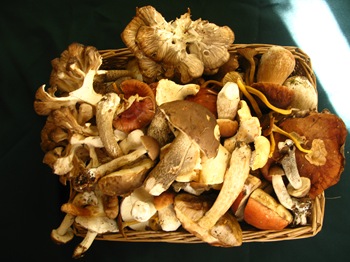
We had booked a day’s course with Fergus to learn how to identify and pick wild foods, having had our appetites whetted by sloe picking earlier this year. What we didn’t anticipate was an adrenaline-soaked adventure lasting the whole day and most of the night. At 9am sharp, Fergus greeted us wearing a wide brimmed hat and carrying a wooden box of eclectic and gnarly looking mushrooms under his arm. He drove us at breakneck speed to a nearby woodland and proceeded to talk very fast and excitedly about all the Latin names and characteristics of the fungi we were finding, barely pausing for breath. Every few feet or so, we would come across a new species of mushroom and Fergus would run around waving his arms, hollering “Come and see this one, it’s even better than the last!” We harvested amazing bulbous cep and boletus mushrooms with their reddish brown tops, delicate chanterelles and something resembling a large brain called Hen of the Woods, growing at the foot of an oak tree:

IMG_6221

N with his prize Cep – what a corker!

IMG_6213

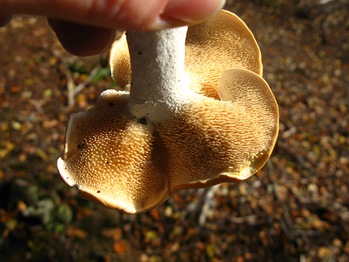
Hedgehog fungus (see the spines):

 IMG_6225

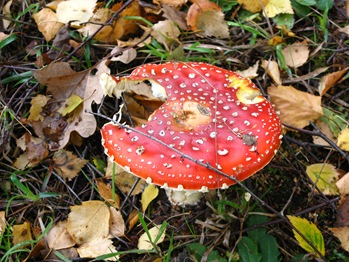
We examined many poisonous fungi, with Fergus telling us to look out for cobwebby threads, milky sap and colour changes when the mushroom flesh is cut into. When we came across the poisonous yet beautiful Fly Agaric toadstool (below), he recounted the time he rubbed some Fly Agaric skin onto the back of his head where it was absorbed by the skin, causing him to collapse immediately and fall down onto his front, with his foraging knife underneath him. “I still don’t know whether I passed out for several hours or a whole day,” he mused. “If the knife had stuck into me, I would have probably died. But if you leach the mushrooms in liquid for a day or so, you can make a great risotto with them.” Hmm, might give that a miss…

Fly Agaric:
IMG_6198

Fergus then produced a flask and poured us thimbles of his own roasted substitute coffee, made from a mixture of roasted goose grass seeds, acorns and some other seeds whose names I can’t recall. It actually tasted remarkably coffee-like, and it turns out that goose grass is in the coffee plant family – fact! As we emerged from the woodland, I noticed some unopened cans of Fosters lying at the roadside – my key contribution so far to the foraging bounty. Fergus seemed very excited, saying he might whip up a beer batter with our dinner later. I wondered if we had just plucked items from the scene of a car accident, as there was lots of broken glass and a couple of hub cabs lying next to the cans…but waste not, want not, right?

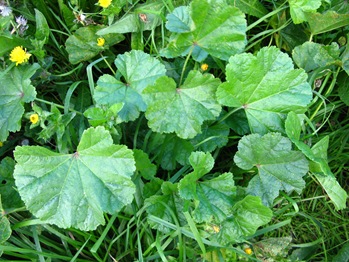
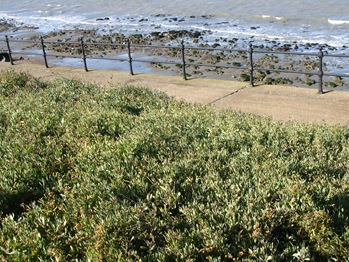
Then to a grassy seashore verge, where we picked bags of Sea Purslane (salty leaves and seeds, tasting a bit like Samphire) Sea Beet (like salty spinach), Alexanders (the leaves and roots taste like a cross between Thai lime leaves and chervil) and mallow leaves (mild and good for salad).

Sea Purslane:
IMG_6229

Common Mallow:

IMG_6228

Alexanders:

IMG_6247

Sea beet:

IMG_6248

Fergus then led us down a steep grassy slope and instructed us to tear off branches of sea buckthorn, whose bright orange berries would make a great pudding later on. It felt a bit wrong pulling actual branches off the trees, but Fergus said he’d been harvesting from the same ones for over seven years and that everything grew back extremely quickly.

Sea buckthorn:

IMG_6252

We then found a tiny apple tree growing miniature fruits – Fergus said that it had most probably grown from an apple pip deposited in a bird dropping. It looked like a tree you might find in Alice in Wonderland – just a bit higher than waist height:

IMG_6250

Then Fergus instructed us to run down to the seashore and harvest seaweed off rocks – all in a sustainable manner, of course, snipping off just enough with scissors so that the roots and stems remained in order to re-grow.

Sea laver (the black stuff):

IMG_6239

It suddenly dawned on Fergus that we were running very late for lunch at his house, as it was now 3pm. I was on the verge of fainting from hunger, and considered the possibility of going and foraging a Mars bar from a nearby local pub, but seeing as we were going to enjoy feasting on the ingredients we had just bagged, didn’t quite have the motivation. A Mars bar might have lowered the tone a bit….but to be honest, I would have eaten my own arm at this stage. “I’m going to freak out,” I whined to my husband, who shot me a look as if to say, “Don’t ruin my birthday treat, you old bag...” I decided to man up and shut up…and before too long we were enjoying an eye-opening lunch at Fergus’s house, all made with the foraged ingredients…

Rosehip and beetroot soup with yoghurt:

IMG_6267

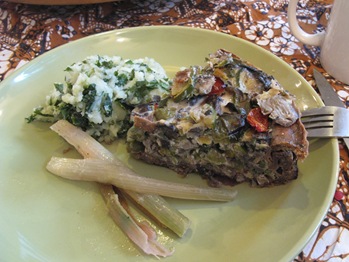
Wild mushroom quiche made with acorn flour pastry, potato mash with chopped Alexander leaves, and braised Alexander stems:
IMG_6275

Mixed leaf salad with raw wild mushrooms, purple mallow flowers and Feta cheese:

IMG_6273

Vanilla pannacotta made with seaweed carageenan and candied bramble stem (black star shaped garnish):

IMG_6276

Sea buckthorn sorbet (amazing – sweet, aromatic and almost alcoholic tasting):

IMG_6277

I asked Fergus how he got into foraging. He said he started as a child, rooting out choice leaves and dandelions for his pet tortoise. “Then when I was at university,” he said, “I was so poor in my final year that I had to live in a tent, eating the remains of stew that the refectory was throwing out. I got heavily into foraging then to survive.” Fergus’s house was filled to the rafters with jars of intriguing looking pickles and preserves, and he owned three freezers to store big batches of produce. He produced a large jar of acorn flour, which was the last of his 18 kilo batch. He had to meticulously pick the acorns, soak them in a river for weeks to leach the tannins out, roast them, remove the husks and grind each kernel. He had no plans to make any to sell commercially, surprise surprise. I asked him what he thought of supermarkets. “They have great toilets,” he laughed. “Plus good car parks, where I can forage lots of plants.” Good answer, I thought.

Full to the eyeballs after our amazing lunch, with a myriad of new flavours dancing on our tongues, Fergus then drove us to some scrubland next to a busy main road, where we harvested rosehips to perfume vodka. “Great if you leave them steeping for six months, then filter the rosehips out, then add dog rose petals for a maximum of 2 days, then leave it for as long as you can bear,” said Fergus. The result would like “nothing you’ve ever tasted before,” he assured us.

Rosehips for the vodka infusion – use the squashy ones for the best flavour:

IMG_6282

We also found wild fennel growing at the side of a council estate, which bore aromatic seeds:

IMG_6278

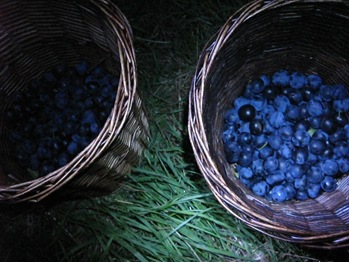
Darkness fell, and Fergus handed out the head torches. We arrived at a pitch black field, and he scampered over to some wild damson bushes growing at the side of a verge. I have never picked fruit by torchlight – it was exhilarating and made us feel like a naughty children. (It wasn’t trespassing as such – Fergus always asks permission from all landowners before he picks plants on their land). We stumbled back to the car with two baskets of dusky blue plums, for that evening’s pudding.

Night time damson harvest:

IMG_6291

IMG_6289

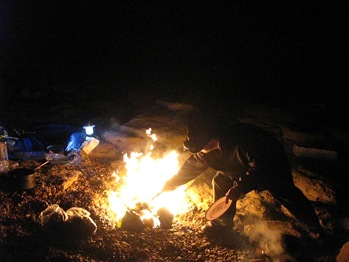
And then back to the beach for dinner. Despite the fact that there was a gale blowing, it was absolutely freezing and that it was intermittently pelting with rain, Fergus insisted that eating a three course meal down on the sand at high tide was the best plan. (The other option was to have dinner in a more sheltered wood, but he admitted that the area was so secret that he had trouble remembering how to find it in the dark). So we stumbled behind him in the gale, head torches blinking, carrying wood, pans, crockery and everything we had foraged that day. Despite the freezing temperatures and the fact that I couldn’t feel my hands or legs most of the time, it was one of the most memorable meals I have ever eaten. Fergus allocated us all various tasks like an army sergeant, then proceeded to make a trio of  fires, grinning like a maniac. He put a wok filled to the brim with vegetable oil over the intense flames, and deep fried four different types of seaweed, and each time he put the wet fronds in the smoking oil, a mini explosion of flames would rise up from the wok. I thought he’d blown himself up at one point…

Fergus gets the oil nice and hot:

IMG_6296

Ka-boom! Fergus adds the wet seaweed to the boiling oil:

IMG_6297

Fergus is still alive:

IMG_6298

Main course was sea bass fried with laver seaweed, fried sea beets with sesame oil, plus fried mixed wild mushrooms. De-licious!

IMG_6302

Pudding was a less successful damson and apple crumble. Fergus forgot the milk for the custard, and thought it would be a great idea to replace the liquid with Fosters lager. Then he added cherry vodka to make it pink. Inedible is an understatement – most of this ended up in the sea!

IMG_6303

I will never forget that evening – there was a moment when I was at the sea’s edge fetching water in a pan from the churning waves and I thought I was going to get swept out to sea when my wellington boot got stuck between two rocks and a huge wave smacked into my legs. As I looked back to the group, I saw the orange embers of our three fires, Fergus gesticulating and waving his arms, and six blinking head torches, with people sat on rocks chopping up apples, stoning damsons and stirring mushrooms in their pan (in the rain). It was surreal, energising and completely mad. I loved every minute!

Cooking dinner in a gale, beach-style:

IMG_6301

Our wild foraging man drove us all back to Canterbury, and I snoozed all the way home, dizzy on cherry vodka. Fergus, you’re a crazy dude and we salute you – thanks for a captivating experience!

IMG_6197

- Wild Man Wild Food – Fergus Drennan’s website

- Fergus cooks roadkill badger and declares owl to  taste ‘of urine’

Wednesday, 4 August 2010

Guilt-free eating out


Last time you went out for dinner, did you worry at all about whether your meal was sustainably sourced and whether the restaurant had any kind of ecological business practices? Chances are that you didn't: the majority of us are usually too distracted choosing something good on the menu, gossiping and worrying about the price of the wine mark-up to really pay this much attention. Or, being British, we're usually too self-conscious to ask whether the pork chops are outdoor-reared.

Did you know that, according to the Environment Agency, the hotel and restaurant industry has the lowest environmental awareness of all business sectors? It’s pretty sobering to learn that food services and restaurant industries chuck out a horrifying three million tonnes of food waste annually, and that restaurants bin a massive 600,000 tonnes of glass bottles every year! It’s enough to make anyone choke, Queen Mother-style, on whatever they are eating, and ask for a doggy bag to take home all leftovers - something which I do often (no, not the choking part!)

But hope is on hand for all restaurateurs in the form of the superheroes at the Sustainable Restaurant Association (otherwise know as the SRA). Founded by restaurateur Mark Sainsbury and ethical business consultant Giles Gibbons, they have made it their mission to get restaurants to behave more responsibly – whether it’s getting their meat from farms with good welfare standards, sourcing ethical fish, reducing food miles and cutting their waste and energy use. It's a pretty tall order.

For an annual fee, restaurants can sign up with the SRA and get all kinds of support in tackling these tricky issues. Many have joined already – I was interested to know that it’s not just trailblazing independents that have become members (such as The Duke of Cambridge, Moro and The Clerkenwell Kitchen) but larger more well-known restaurants or chains such as Carluccio's, Canteen, Leon and Le Manoir aux Quat'Saisons. (I now am forced to hate Carluccio's a little less...even though I find their branches as charmless as a punch in the face, with bland food and deafening acoustics!)


Recently the SRA put on a foodie evening out and bravely invited a motley crew of food bloggers (including me) to demonstrate to us how restaurants in the Clerkenwell area of London are all getting on board with the sustainability message. Our first stop was The Clerkenwell Kitchen for a starter, where they treated us to summery loveliness in the form of courgette and goats' curd canapes, and a salad of mixed leaves, peas and eggs with homemade salad cream (see above). Then we hopped over the road and ate a divine main course of sustainably-fished sea bass with chermoula and quinoa at The Modern Pantry (who I might have now forgiven for a previously lacklustre brunch). Finally, we heaved our rotund selves onwards to The Zetter to eat a delectable raspberry and passionfruit sable, with fresh mint teas and chocolate truffles. All three of these restaurants demonstrated clearly that you can still serve wonderful, luxurious food that tastes exciting, while still staying true to ethical ideals without forcing people to wear hair shirts, stroke their beards and eat lentils.

The Clerkenwell Kitchen's impeccably-sourced sweet peas:


If you'd like to know more about the SRA and its noble aims, all the info is here. If you happen to be padding about Clerkenwell, I'd recommend a meal at any of the three restaurants above. Perhaps some of you could be persuaded (if you don't already) to ask a few more questions when you eat out - remember all it takes is a few people nagging to see small things start to change for the better. Ask where the mystery meat comes from. Don't be afraid to find out if the restaurant recycles. And if you can't finish that whopping steak, always ask for a doggy bag, the absolute epitome of foodie chic!

The Clerkenwell Kitchen
The Modern Pantry
The Zetter

Sunday, 25 July 2010

Get your fruit from the man on the street


The fruit you can buy from small market stalls peppering London's pavements might not be organic, or always sourced from UK farms, but I think it tastes so much better than what you can buy in the supermarket. These stalls aren’t flashy or posh – they’re just geezers selling fruit out of cartons at the roadside. But the difference in quality compared to a supermarket is amazing – when I buy a nectarine or apricot from a supermarket, three times out of five they are bullet hard and either go mouldy upon ripening, or don't taste of anything much at all.

I would like to say a big 'hurrah' for my regular 'Fruit Man' whose stall is near House of Fraser on Victoria Street in central London. Recently I have bought nectarines from him that are properly ripe upon purchase or that ripen to perfection in the fruit bowl, and taste so perfumed that you believe that they have fallen off the tree in Italy into your lap. The same goes for his fantastic white peaches – the curiously shaped flat variety – they taste so good! Until recently I had banned myself from buying apricots in the supermarket, because they are so disappointing, but you can ripen up the ones from his fruit stall until they almost taste of summer in the South of France...

Fruit Man of Victoria Street is there every week day, transistor radio blaring out classical music, and he always stocks the more interesting varieties. For example, I had never encountered a flat white peach before seeing them here, and he always has interesting seasonal UK produce, such as the best of the strawberries, raspberries and greengage plums. You can smell the heady aroma of the berries when you pick the cartons up, wafting out of the punnets like an intoxicating drug!

Fruit Man always adds the personal touch – he can tell you how long to leave something to ripen up, or what’s tasting particularly good that day. He is proud of the fact that he gets his fruit fresh from Covent Garden market every day. “I don’t eat rubbish,” he says. Quite right. He adds lovely signs written in old fashioned handwriting, with messages such as ‘Please don’t squeeze me until I’m yours’ and is excited about the figs and grapes that will soon be flooding in. Sometimes he pops a free avocado into my bag.

Here is some of his produce lovingly installed in my tiny kitchen...

Yellow nectarines and flat white peaches (note the smaller, more insipid nectarines on the far left that come from Sainsbury's), and apricots in the paper bag:


White nectarines and greengage plums:


Why would I buy my fruit anywhere else? You don’t get this service in the bleak over-refrigerated atmosphere of a Tesco. By buying your fruit from small stalls, you're supporting small independent businesses and not doing all your food shopping through the supermarket monopoly. Spending a few less quid per week in the supermarket won't hurt the fatcats one little bit, but it will make a huge difference to the fruit man on the street. Right on - and peachy!

Got a favourite market street stall you can recommend? I want to hear about it...

Monday, 12 July 2010

Lumen Cafe


Note: Lumen cafe is no more. Well, it's not run by Charlotte Jarman any longer - she and the cafe parted ways two weeks ago, because the charity that managed the cafe were a bunch of awkward buggers who made her life hell. It's their loss - Charlotte can now be found cooking part time at the superb Clerkenwell Kitchen. Hurrah for her!

My friend Charlotte Jarman (the best cook I know) and her friend Kate de Syllas have opened a wondrous cafe just a stone's throw from King's Cross. In what seems to be a desert of good places to eat, they are serving exciting food that is a mix of Middle Eastern, Mediterranean and British flavours, all impeccably and ethically sourced. Charlotte has worked as the Greener Food project manager at London Food Link (part of Sustain), and knows a thing or two about how to run a restaurant that sources its food locally, using meat, dairy and fish that has been responsibly farmed and fished, and above all, selecting ingredients that taste gorgeous.

Everything you will eat at Lumen Cafe tastes as though sunshine is bursting out of it - fresh, interesting ingredients that are all from great British farms. Fear not, though, you don't get its ethics rammed down your throat - the cafe's sourcing policies are discreetly written up on chalk boards, should you so wish to get a bit more info.

I popped in for lunch recently and blissed out on the following...

Sweetcorn bhaji with mixed leaves and raita: very sexy flavours. I even liked the raw onions, because Kate had done something magical to them by steeping them in lime juice and adding mustard seeds, annihilating the oniony aftertaste:


Tortilla with garlic aioli: I had an OMG moment with the aioli, and requested an extra bowl with bread to dip in it. The tortilla was very satisfying too, and did its best to soak up my hangover.


Vanilla sponge cake topped with whipped cream and Chegworth Valley strawberries: worth walking barefoot across crushed glass for...just dreamy!


I would have liked to have lingered there all afternoon, eating dish after dish. I know that the brownies served here are exemplary - I use Charlotte's recipe again and again, it's the best one I know. Lumen Cafe's prices are extremely reasonable, especially when you consider the high calibre of the ingredients. You'll average about £6 for a good sit-down meal. Even the sandwiches are something to be celebrated: Charlotte and Kate insist on good bread from Born & Bread, stuffing it with delectable fillings such as roast chicken and herb yoghurt, or homemade egg mayonnaise. Yum!

Get over there and prepare to undo at least one button on your jeans in honour of the feast. Oh, and hurrah for their glowing review in Time Out...they well deserve it!

Lumen Cafe
88 Tavistock Place
London WC1H 9RT

Monday, 19 April 2010

Geetie's dark chocolate pots


If you haven't heard of Geetie Singh, well, she's pretty much a legend on the UK organic food circuit. She's like the lone ranger of organic restaurant eating - not only is she a female restaurateur (in a very male-dominated trade) but she founded and still runs the UK's only existing Soil Association-certified gastropub: The Duke of Cambridge, based in Islington, north London. You will find her regularly in the pub chatting with staff and suppliers, often accompanied by her baby daughter and chocolate coloured labrador. She grew up on a commune where they grew all their own veg and made all their own bread, and grew her pub business from nothing. She's a cool dude!

It's really tough running an organic restaurant - not only is every morsel of food sourced to the very strictest of Soil Association standards, but the chefs cook according to the seasons, changing their menu twice daily. They only use small independent producers with impeccable credentials. And the pub - wow, it's lovely! Really cosy and warm, with wonderful food that is both hearty yet sophisticated. The chefs make all their own bread, ice cream and pickles.

Geetie has just published her first cookbook, co-written with her head chef Sara Berg, and I made the chocolate pots recipe at the weekend. It's rich, chocolate heaven: tastes eye-poppingly decadent yet is easy to make.

Geetie's dark chocolate pots - from 'Geetie's Cookbook: Recipes from the kitchen of the Duke of Cambridge organic pub'

Serves 4

You will need:
170g 70% dark chocolate (I used Green & Black's)
200ml double cream
110ml milk
2 egg yolks
100g icing sugar


Put the chocolate in a bowl and melt over a saucepan of simmering water. While this is melting, mix the cream, milk and egg yolks in a large bowl. Sieve the icing sugar into the cream mix. While the chocolate is still hot, add this to the cream mix and whisk. If it does not thicken up, place back over simmering water for a few minutes while whisking. Pour into ramekins, cups or glasses, and put them in the fridge. Serve on their own with biscotti.

I served mine with soft almond amaretti where I substituted the orange zest and orange flower water with ground cardamom, which goes really well with chocolate.

Monday, 28 September 2009

Proper Motorway Nosh: The Real Food Cafe


Last time I wrote, I was having a proper old moan about the lack of decent food options when on the road, venting my fury towards motorway service stations serving crap tucker, and lacklustre port-side sandwich merchants. But hark, I now have reason to rejoice! Quite by accident, on our way to the Lake District from Scotland, we chanced upon The Real Food Cafe - a motorway eatery with a difference, located on the A85 which crosses the breathtakingly beautiful Loch Lomond and Trossach National Park. It serves homemade, locally sourced food - and nothing comes out of a packet!

Ironically, this used to be a Little Chef. But now, instead of boil-in-the-bag and fried food swimming in grease, you can now feast upon freshly homebaked breads and cakes, roasted free range chicken, sustainable fish 'n chips, homemade Highland beef burgers, hearty vegetable soups and all manner of salads. You eat with real cutlery instead of everything being disposable, and my soup came in a porcelain bowl. And lo - they have a fresh cakes counter (always a hotline to my heart) groaning with flapjacks, millionaire's shortbread, Victoria Sponge - and even meringues! (Can you imagine eating a meringue in a service station? Neither can I. The mere notion feels as though the world is turning in on itself. But at The Good Food Cafe you can do this without fear!).

As we sat and ate our delicious meal (veg soup with crusty bread; fish 'n chips in light, crispy batter; buttery shortbread) a very smiley lady popped a fresh tray of warm scones onto the table right next to us. She was even humming a tune. Birds pecked at feeders right outside the window. What a jolly place! It is quite bizarre going to the loos and seeing that they're probably the same ones from the building's Little Chef days: it's like The Little Chef became a grown up.

Light-as-air batter on the fish (and very crispy chips):


The illustrious cake counter:


The Real Food Cafe's story is thus: Sarah Heward and Steve Wolsey took on the struggling Little Chef and transformed it into a haven of good food in 2005. Sadly Steve passed away in 2006, but Sarah continues to run the cafe, determined to serve the best possible grub to weary drivers and hikers. As much of their produce as possible is sourced from the local area - for example, sausages from the nearby glen and beef from the Isle of Mull. They make all their own bread - and for that alone, I salute them. Here's hoping we see some more people follow suit and maybe slowly our on-the-road eating options can improve...